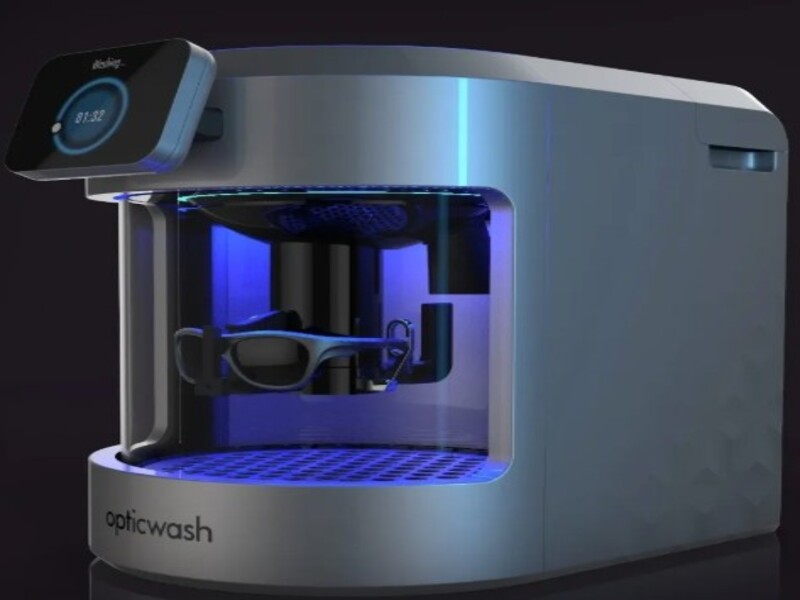
Opticwash Elite:A Self-Service Glass Wash…….
The Consumer Electronics Show (CES) in Las Vegas 2026 placed a global spotlight on hygiene, automation, and contactless services, which are becoming increasingly important in public infrastructure. Opticwash Elite, an advanced self-service cleaning and sanitisation kiosk for eyewear, jewellery, and water-resistant cellphones, is a prime example of this trend. You may call it a "self-service wash for your glasses" and may find it in busy places like airports, shopping malls, and professional vision centres in United States.
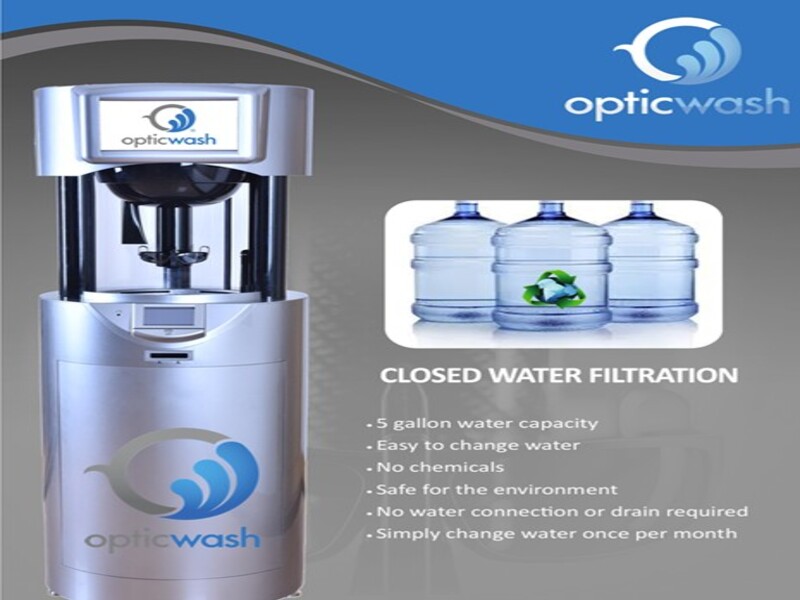
Image Sources : https://www.opticwash.com/wp-content/uploads/2023/03/opticwash-PRO-eBrochure.pdf
WHO DESIGNED?
The device was conceived by Bryan Myers, who built the original prototype in his garage. Its evolution from an early concept into a commercially viable product was driven by a strategic partnership between Myers, his brother Brandon Myers, and Gary Lim of the branding agency HOW Creative. Lim and his team were instrumental in repositioning the product, rebranding it from 'Shade Saver' to 'Opticwash', while also leading the design of the kiosk’s refined, contemporary interface and contributing to the development of a scalable, market-ready business model.
HOW THE OPTICWASH ELITE OPERATES?
The Opticwash Elite delivers fast, automated cleaning through a soap-free, three-phase system, completing a full cycle in less than two minutes while protecting delicate surfaces.
-STEP 2 : Advanced Multi-Layer Filtration - During circulation, the water is passed through a dual filtration system consisting of a 5-micron activated charcoal filter and a 0.2-micron absolute membrane. This combination captures extremely fine particles, including contaminants invisible to the naked eye, ensuring consistent cleanliness throughout each cycle.
-STEP 3 : UVC Germicidal Disinfection -In the final stage, items are exposed to ultraviolet-C (UVC) light through Ultraviolet Germicidal Irradiation (UVGI). This technology neutralizes up to 99.9% of bacteria, viruses, and molds, delivering a level of sanitization comparable to clinical standards.
COST STRUCTURE
-Per-Use Pricing: In public environments such as airports, shopping centers, and transit hubs, a single cleaning session typically costs USD $1–$2. Kiosks commonly support cashless and contactless payments, including cards and mobile wallets.
-Equipment Investment: For organizations purchasing an Opticwash Elite unit, pricing generally falls between USD $10,000 and $20,000 or more, depending on configuration, service coverage, and maintenance agreements.
KEY BENEFITS
-Lens-Safe Operation: The system uses very low water pressure (approximately two pounds), eliminating friction and preventing scratches that can occur with cloth or paper cleaning methods.
-No Chemicals or Heat: The absence of solvents, soaps, or thermal processes makes the system safe for premium lens coatings and sensitive frame materials.
-True Disinfection: Unlike basic cleaning methods, Opticwash provides verified sanitization, making it especially valuable in healthcare, retail, and high-traffic public settings.
MORE INFORMATION
To access more information, Watch this video : https://www.youtube.com/watch?v=_AW-ieEpIwE
Also Read : Self-delivery robots are now on Japan's streets